
What Parents Should Know About...

  1. Adequate Yearly Progress
    Yearly progress goals set by each state, which are used to track the improvement, or lack of, in public schools. The federal government does not set these standards, each individual states sets its own standards.
  2. In Need of Improvement
    Schools that do not meet the yearly progress goals (standards) set by the state, for two years in a row, are called �In Need of Improvement.�
  3. Public School Choice
    The right to transfer your child from a school that is �in Need of Improvement� to a better performing public school or charter school. In certain cases, transportation is provided.
  4. Supplemental Educational Services
    Eligible students can receive free, extra help (tutoring) from a state � approved provider, which takes place before or after school.
Schools in Need of Improvement Lists
List of BAEO chaper cities with schools in need of improvements

  1. Detroit (PDF)
  2. Milwaukee (PDF)
  3. Philadelphia (PDF)
Project Clarion Downloads
External Links
A description of the links provided below.

  1. No Child Left Behind
    The official U.S. Department of Education website on NCLB.
  2. Tutors for Kids
    Under the NCLB Act of 2001, low-income children in public schools �in need of improvement� can receive free tutoring, also called supplemental educational services (SES).
  3. GreatSchools.net
    Your objective source of school information on elementary, middle and high schools.
  4. Info. on Public Schools and School Districts
    The National Center of Education Statistics list of schools in the United States.
How You Can Help
Every person can help a child get free tutoring or access to a better education by spreading the word about these options under the No Child Left Behind Act.

  1. Click here for more information
Other Programs
NCLB/Project Clarion
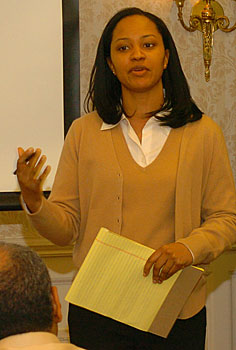
Monique Miller, Director of Project Clarion, discusses the program�s progress with Symposium �04 participants.
Project Clarion is an outreach campaign designed to give parents facts about the No Child Left Behind Act (NCLB) and help them to exercise their rights in select cities with BAEO chapters. These cities have a high number of low-income black families in at-risk communities with children in schools identified as in need of improvement by State Education Agencies.

The No Child Left Behind Act of 2001 (NCLB) is a landmark in education reform designed to improve student achievement and change the culture of America's schools.

Our goal is to provide parents with information about the Public School Choice and Supplemental Educational Services (free tutoring) provisions under NCLB. Also, we want to provide parents with information on charter schools and other educational options in their communities to help their children, if they do not qualify for the public school choice and free tutoring services under NCLB.

The Black Alliance for Educational Options (BAEO) is a national, non-profit, non-partisan organization whose mission is to actively support parental choice to empower families and increase quality educational options for black children.

To further this mission BAEO was awarded a five-year, multi-million dollar grant by the US Department of Education in the fall of 2004 to educate low-income and working-class black families about their rights under the No Child Left Behind Act.

Children who enter school with language skills and pre-reading skills (e.g., understanding that print reads from left to right and top to bottom) are more likely to learn to read well in the early grades and succeed in later years. In fact, research shows that most reading problems faced by adolescents and adults are the result of problems that could have been prevented through good instruction in their early childhood years (Snow, Burns and Griffin 1998).

It is never too early to start building language skills by talking with and reading to children. NCLB targets resources for early childhood education so that all youngsters get the right start.

It is imperative to empower parents to exercise their rights, because when parents are given a choice, children are given a chance.