
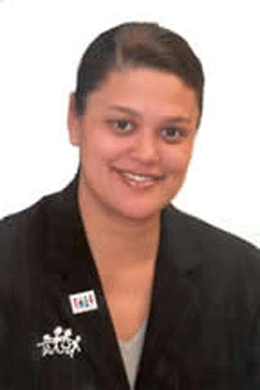
�If we are to arrive at equity for all students in education, we must begin looking deeper to see those ugly, but true differences that are startling, yet real,� Dr. Clifford Thompson, a MSR online reader from California said in response to the February 15 article titled �St. Paul also faces achievement disparities in its public schools.� In a recent conversation with the superintendent of St. Paul Public Schools (SPPS), Dr. Meria Carstarphen, some of those differences were examined.
Dr. Carstarphen joined SPPS in August 2006. Prior to this, she was Washington, D.C.�s school system chief accountability officer for 18 months. �Dynamic,� �passionate,� and �committed� are among the adjectives that the people who work with Dr. Carstarphen use to describe her.
She is very visible in the community, meeting extensively with students, parents, staff and community groups. According to SPPS administration, the superintendent also leads extensive efforts to raise additional financial resources from public and private sources to support school improvement.
The following are excerpts from an MSR conversation with Dr. Carstarphen (MC):
MSR: Several readers of this newspaper�s February 15 article (�St. Paul faces achievement disparities in its public schools�) expressed surprise that the achievement gap between African American students and Caucasian students is so wide. Many readers, on the other hand, were not so surprised. And, in fact, just as many were indifferent opining that the achievement gap has been around for so long that it has become the status quo and will never change.
MC: I have yet to work in a school district where there wasn�t an achievement gap between African American students and the highest performing group, which is typically Caucasian, although it�s getting to be more Asian American. I haven�t worked in a district, even when it�s 95 percent black like Washington D.C., where there isn�t a very significant achievement gap.
Here�s what I think. Factually, nationally it has been a standing trend. There is no doubt that every urban large school district in America, even small ones, not urban, isn�t experiencing this � that�s a fact. And yes, it�s true; it has been that way for a very long time, so we should not be surprised.
MSR: In January 2001, Congress passed the No Child Left Behind Act of 2001 (NCLB). According to the U.S. Department of Education, NCLB is designed to change the culture of America�s schools by closing the achievement gap, offering more flexibility, giving parents more options, and teaching students based on what works.
MC: If there is one benefit to NCLB, it told every district in America that you can run, but you can�t hide. Yes, it�s under-funded. No, they haven�t done enough for special education, and so on. I know there are problems with the law and the implementation, but it means we�re going to spotlight this issue and we�re going to spotlight it every year, and you must make progress. You must work towards the targets and benchmarks set by the federal government.
I believe that if we have the will to change outcomes for kids, it will be done. We know we have good leaders in districts. We know we have good superintendents. We have good teachers, and we know we can serve even better.
We can serve kids whose language is not English. We serve kids very well all up and down the spectrum of those five groups � Caucasian, African American, Asian American, American Indian, and Latino. So, in many ways, we serve different kids at different levels. What we consistently do is never serve African American students well.
MSR: The U.S. Department of Education report that NCLB is working. �The long-term Nation�s Report Card (NAEP) results, released in July 2005, showed elementary school student achievement in reading and math at all-time highs and the achievement gap closing.� Do you expect changes in SPPS?
MC: Do I think it can change? Absolutely. If we have the will to do what we�ve done like we�ve done for many other communities across this country. If we have the will to serve African American families and kids, we will do it. So do I think it can change? Absolutely. Do we have the will to make the change? That is the question.
MSR: Where do we start?
MC: There is only one way to break out of this nightmare � I�ve got to get kids ready for the first grade. I can�t emphasize enough with the African American community how important it is that you are careful and thoughtful about daycare.
You have kids and you have to work, and I understand that. But there�s a difference between sending your child to your neighbor or the grandmother and turning on the TV, or deliberately looking for daycare, even if it costs. That starts introducing socialization and literacy early on. And, there is a difference.
What we also know about child brain development, those first couple of years of a child�s life, even before I even hope to see them in public school, are so important. Give your kid the greatest gift you could ever ask for. Before they come to me, I need parents to do early childhood and family education of which St. Paul does really well.
St. Paul invests millions and millions of dollars in early childhood education, and it�s free. So just use it. Learn how to play responsibly. St. Paul has an Early Childhood Family Education (ECFE) program, which offers�early childhood education for families with children between birth and kindergarten age.
If we get kids ready for first grade, then all we need to do is then teach the standards of the state really well. Our job as educators is to take the next step. Kids must be reading at or above grade level by the third grade. If they don�t, by the time they make it to the 10th grade, they�ll be in the bottom 10 percent of the class.
If it�s not right early, we spend a lifetime of safety netting, intervening, extra supporting, etc. If families take responsibility for those early years of their child�s development, I say we can transform an entire community within 10 years.
MSR: If you successfully close the achievement gap in St. Paul, you�ll be a hero to our community. What are your thoughts on that?
MC: I don�t think I�ll be a hero. I think I�ll be doing my job. Sometimes kids come to us from the side such as the refugee population, and they are exceptions. But for the kids who start with us and for the parents who take advantage of early childhood education, there should be no excuse why the kids can�t read by the third grade.
So if we close the achievement gap, we�d be just doing our job. That�s what I�m here for. I believe in St. Paul we have all the resources to become the first district in the state to shut the gap, close it all up. We have teachers and principals who do it every day right here in St. Paul.
Superintendent Meria Carstarphen shares her goals and vision for the school district and learning about community views of the school district at a series of community-sponsored events. All of the events are free and open to the public. Parents and others are encouraged to attend whichever meeting is most convenient and to share your ideas, concerns, and suggestions with Dr. Carstarphen. Visit the SPPS website www.spps.org for the schedule of meetings.
For more information about ECFE programs call 651-793-5410, or visit the website http://ecfe.spps.org.
Jennifer Holder welcomes reader responses to [email protected].
submitted: March 7, 2007 - 11:09pm
http://www.tcdailyplanet.net/node/3910